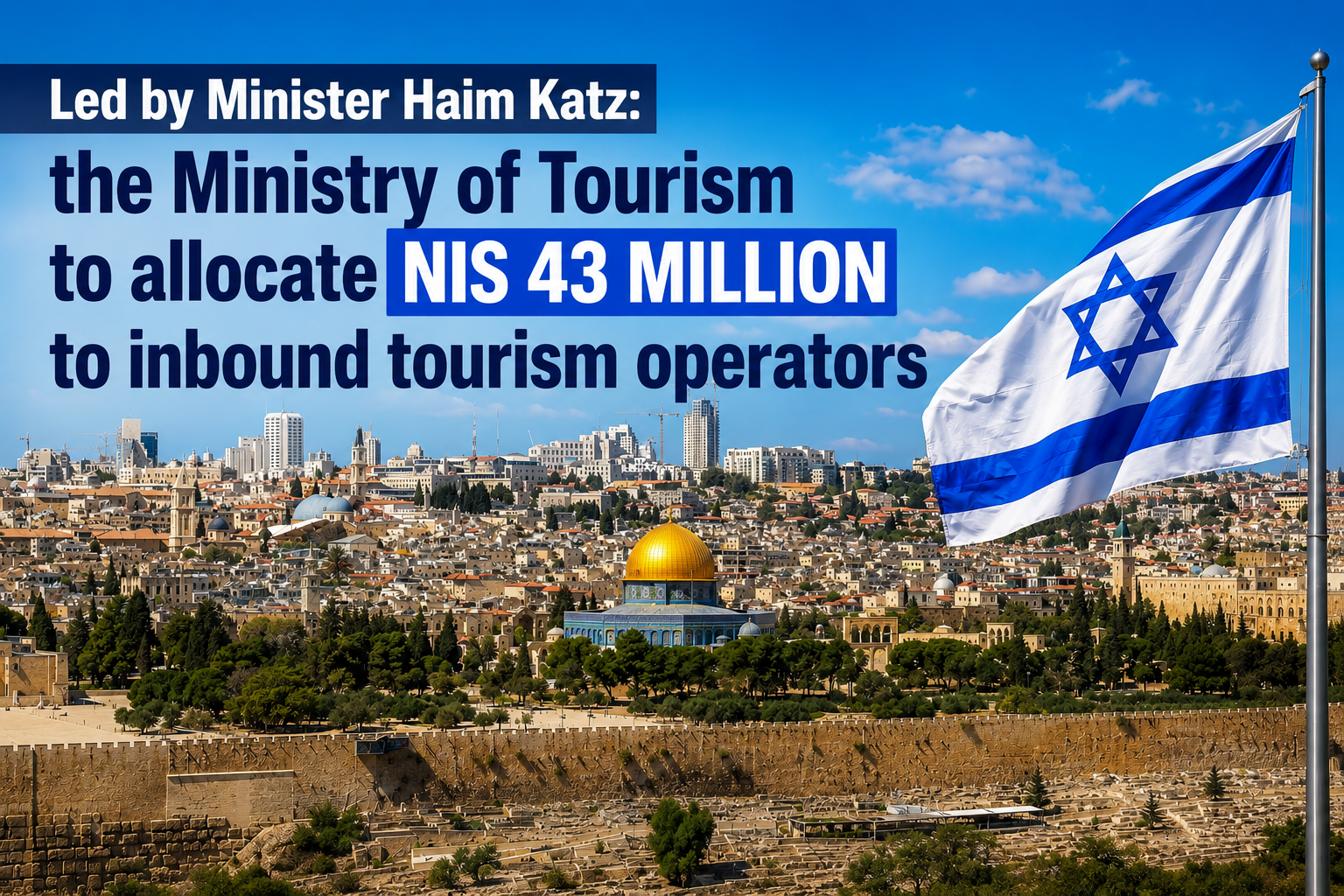
The government has approved Tourism Minister Haim Katz’s framework for the retention of essential employees, totalling NIS 35 million. In addition, the Ministry of Tourism will provide operators with NIS 8 million through a dedicated fund to encourage marketing activities abroad and boost tourist traffic to Israel.
The government recently approved Tourism Minister Haim Katz’s NIS 35 million framework for inbound tourism operators in Israel, whose revenues have been significantly impacted by the sharp decline in tourist arrivals as a result of Operation Roaring Lion.
At the same time, the Ministry of Tourism will provide inbound tourism operators with a dedicated fund of NIS 8 million, designed to support marketing activities abroad and encourage the return of tourism to Israel. The fund will assist operators in financing marketing activities, campaigns, participation in trade fairs, professional events, and activities to promote Israel as a tourism destination as part of the Ministry’s policy, led by Minister Haim Katz, to preserve Israel’s international marketing infrastructure even during the crisis period.
The employee retention framework is in addition to the NIS 70 million budget previously allocated to inbound tourism operators following Operation Iron Swords.
Now, against the backdrop of the ongoing damage to inbound tourism and the impact of Operation Roaring Lion, an additional assistance procedure has been formulated for the retention of essential and professional employees for a period of 15 months. The initiative is designed to ensure that when the fighting subsides, the industry will have skilled personnel available to carry out effective marketing activities to bring tourists from abroad.
Tourism Minister Haim Katz said: “This is another step we are advancing for inbound tourism operators, who serve as a significant anchor in marketing and increasing the number of tourists arriving in Israel. In normal times, tourism supports thousands of families and brings tens of billions of shekels into state coffers each year, and in times of crisis we are committed to helping preserve the essential infrastructure that is a central factor in recovery. The dedicated budget will enable operators to retain essential employees, professional knowledge, and business relationships built over many years, as well as to carry out activities to strengthen our position as a leading tourism destination on the day after.”
Key points of the assistance framework approved by the government:
Total budget: NIS 35 million for the employee retention framework. Framework period: 15 months, from May 2026 through July 2027. Eligibility threshold: An inbound tourism operator whose inbound tourism revenue in 2023 stood at at least NIS 1.5 million.
Revenue decline mechanism:
Financial assistance will be granted in four consecutive instalments, subject to a decline of at
least 70% in revenues compared to equivalent periods:
- First instalment (May–June 2026): decline of at least 70% in revenues compared to the equivalent period in 2023.
- Second instalment (July–September 2026): decline of at least 70% in revenues compared to the equivalent period in 2023.
- Third instalment (October–December 2026): decline of at least 70% in revenues compared to the equivalent period in 2022.
- Fourth instalment (January–July 2027): decline of at least 70% in revenues compared to the equivalent period in 2023.
Employee salary participation model and quota cap:
- Assistance will be granted for employees engaged in inbound tourism as of April 30, 2026, who worked continuously from that date through the instalment period.
- Assistance amount per position: the state will contribute up to 93.75% of the lower of the two: the employee’s actual salary or the average wage in the economy.
Read more at TravelMail | Follow us on Facebook | Twitter | and Instagram for on-the-go news