
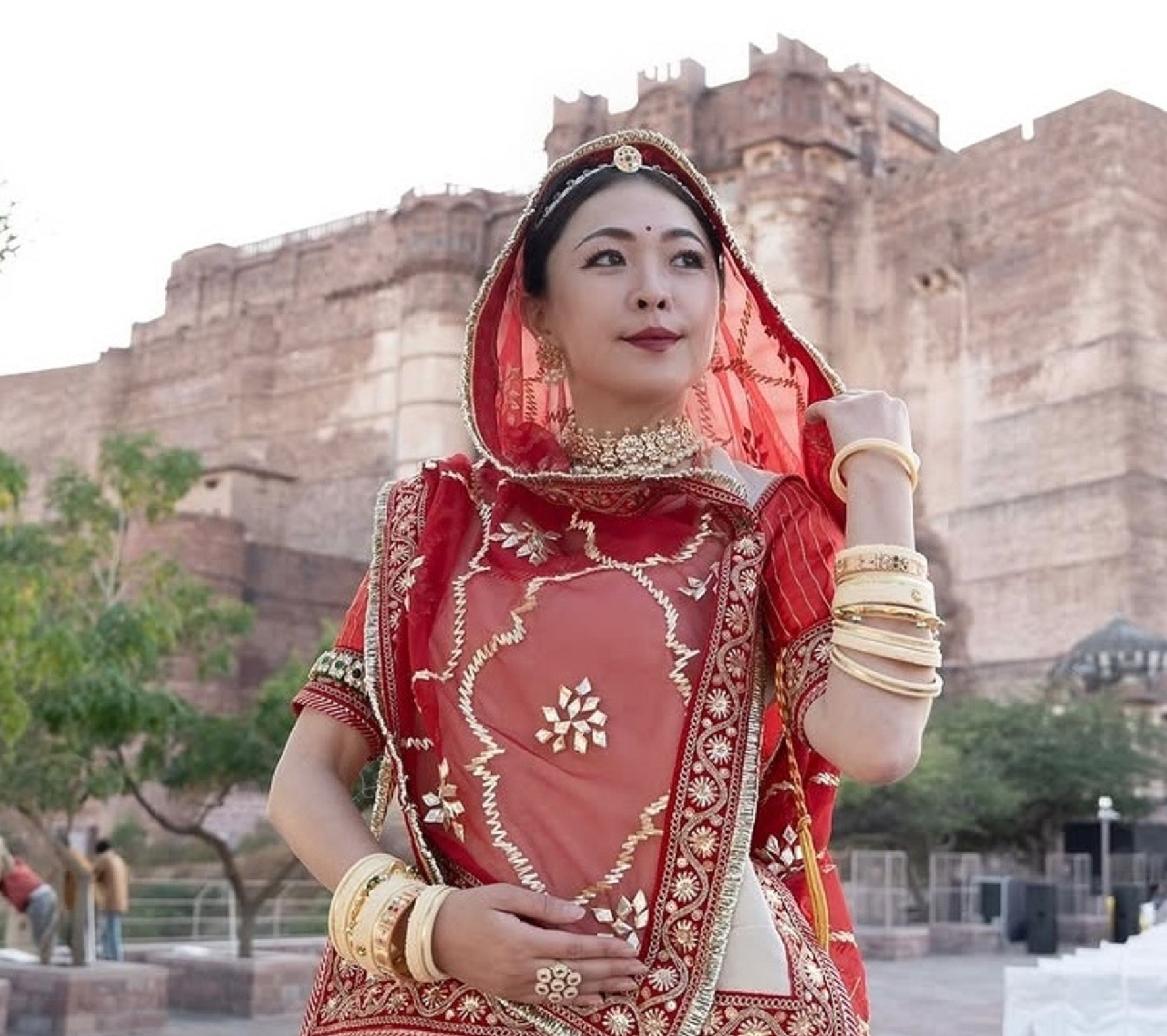
On an evening shaped by the colours of Gangaur, where geet, ghoonghat and graceful movements fill the streets of Jaipur, a dancer moves with quiet certainty. Draped in leheriya and guided by rhythm, she blends into the celebration with ease. Few would guess she was born thousands of miles away in Tokyo.
Today, she is known as Rajasthani Madhu. Years ago, she was Mayumi of Japan.
Her story begins not in Rajasthan or in India, but inside a cinema hall in Japan. Watching an Indian film introduced her to a landscape she had never seen, yet somehow understood. The music stayed with her, and the visuals lingered long after the credits ended.
In 2009, curiosity led her to India, and eventually to Rajasthan. What followed was neither a short visit nor a passing interest. It became a process of learning and unlearning.
She sought out folk artists and began training in Kalbelia, Ghoomar, and Chari. Under the guidance of Kalbelia exponent Asha Sapera and through her exposure to the Manganiyar tradition shaped by Anwar Khan, she discovered that these art forms carried memory, emotion and identity within them. They were not performances to replicate, but traditions to live.
Time spent in Jaisalmer brought a quiet shift. The desert and its music and its people began to feel familiar. Somewhere along this journey, Mayumi became Madhu. The name did not mark reinvention, but recognition.
Back in Tokyo, her life reflects this dual belonging. By day, she runs a beauty salon, and by evening, she transforms her space into a small centre of Rajasthani culture. Three to four times a week, she teaches folk dance to Japanese students. The room fills with colour and sound, and steady footwork as Rajasthan finds expression far from its origin.
The path has not been simple. Introducing regional Indian folk traditions to a Japanese audience comes with its own challenges, and there are days when only a few learners attend. Yet, her commitment has remained steady. Support from students and a growing digital audience continues to shape her journey forward.
Her connection to Rajasthan has also been acknowledged by the state tourism bodies, which have invited her to participate in fairs and cultural festivals. In these spaces, she is not seen as an outsider learning the culture, but as someone who carries it with sincerity.
Madhu describes Rajasthan as her second home, though the distinction feels increasingly subtle. Her journey reflects how culture travels, not as an export but as an experience that takes root in unexpected places.
From Tokyo to the Thar, her story speaks of a connection that goes beyond geography and beyond language. It is shaped by rhythm, memory and a sense of belonging that cannot be measured.
Read more at TravelMail | Follow us on Facebook | Twitter | and Instagram for on-the-go news